
Container Maintenance Tips for IVF Professionals
If you work in an IVF lab, cryobank, or reproductive storage facility, you already know one thing: your cryogenic containers are not just equipment, they are guardians of future families. These containers hold embryos, oocytes, sperm, and reproductive tissue that patients trust will remain protected for years, sometimes decades. But maintaining cryogenic containers isn’t as […]
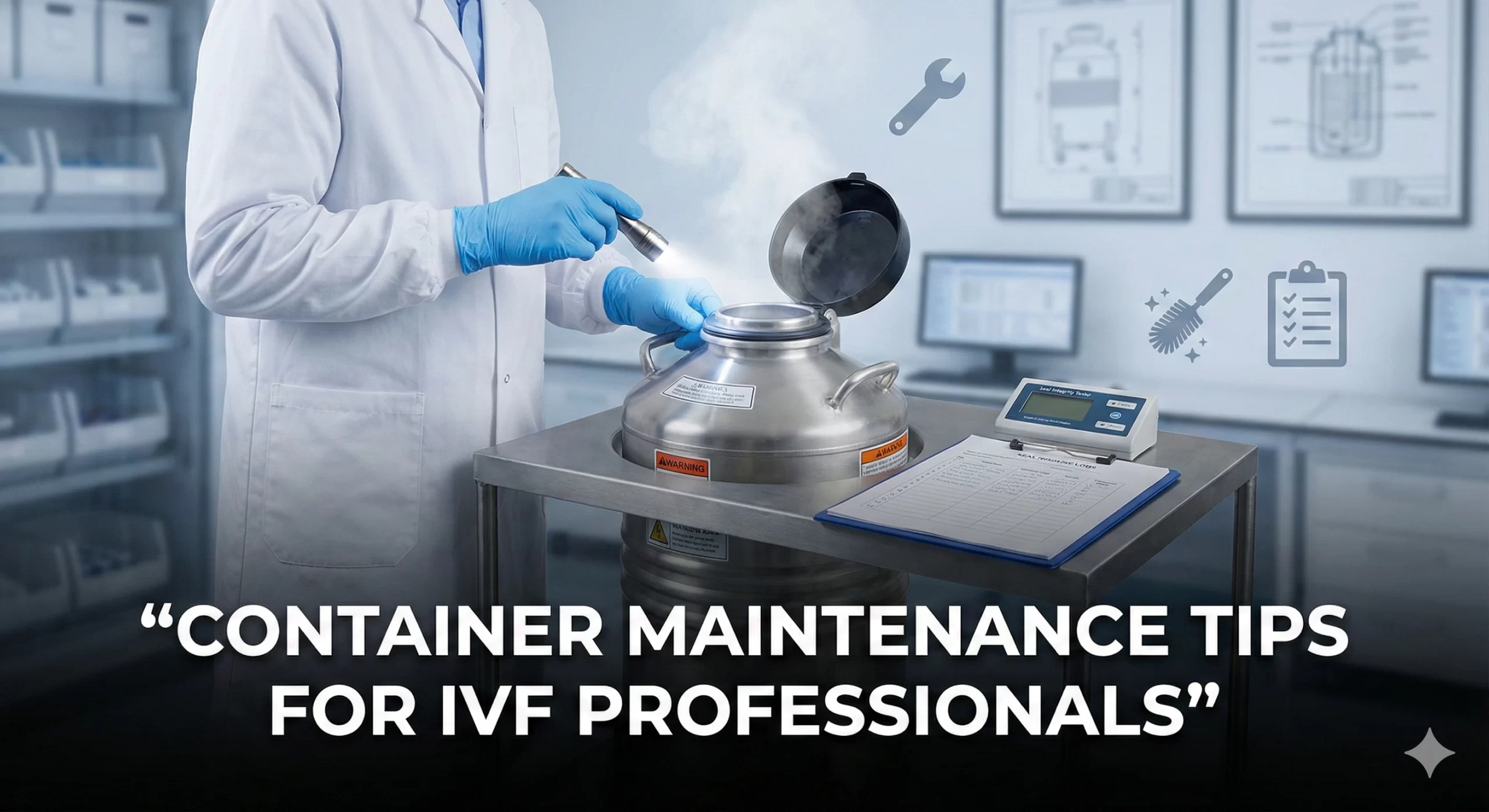
If you work in an IVF lab, cryobank, or reproductive storage facility, you already know one thing: your cryogenic containers are not just equipment, they are guardians of future families. These containers hold embryos, oocytes, sperm, and reproductive tissue that patients trust will remain protected for years, sometimes decades.
But maintaining cryogenic containers isn’t as simple as keeping them filled or checking alarms once in a while. It requires routine observation, proactive care, and a solid understanding of long-term equipment behavior. Small shifts in temperature, nitrogen usage, or insulation integrity can be early signs of a much larger problem.
So today, instead of taking a textbook approach, let’s talk through container maintenance like colleagues, in a way that feels practical, natural, and easy to implement in a busy IVF workflow. Because when it comes to cryogenic storage, proactive maintenance isn’t optional, it’s your strongest layer of prevention.
Container Maintenance Tips for IVF Professionals
1. Monitor Liquid Nitrogen Levels Consistently
Liquid nitrogen (LN2) is the heart of the cryogenic storage environment. Maintaining consistent levels prevents exposure to temperature fluctuations and minimizes the risk of warming events.
A good routine involves:
- Daily quick checks
- Weekly logging
- Monthly trend analysis
Instead of just refilling as needed, look for patterns. If consumption increases suddenly or gradually over time, that may signal insulation degradation or vacuum weakening.
2. Track Evaporation Rates and Boil-Off Trends
Evaporation rate is one of the most reliable health indicators of a cryo container. Healthy containers maintain predictable LN2 loss rates. A sudden increase often means:
- Seal degradation
- Structural changes
- Internal vacuum failure
- Lid wear or improper closure
Changes don’t always require immediate panic, but they always require investigation. Logging evaporation monthly helps detect issues early before they become emergencies.
3. Inspect Seals, Lids, and Exterior Surfaces Regularly
Cryogenic containers can look perfectly fine from a distance, yet subtle wear can compromise performance.
During routine inspections, check for:
- Cracks or dents
- Rust or corrosion
- Loose or damaged lid seals
- Condensation patterns or frost where it shouldn’t be
If frost forms around a seal line or valve area, it’s a red flag that the container is losing insulation integrity and needs servicing or deeper evaluation.
4. Keep Temperature Monitoring Systems Active and Calibrated
A container may function, but without accurate monitoring, you’re operating blind. Temperature monitoring isn’t just a feature, it’s your early warning system.
Key steps include:
- Annual calibration
- Battery backup testing
- Remote access verification
- Alarm threshold auditing
Monitoring should be both continuous and documented. If your system relies solely on manual checks, it’s time to upgrade to automated monitoring.
5. Document Performance Data and Maintenance Logs
One of the strongest habits IVF professionals can establish is keeping proper logs. Documentation helps you:
- Predict replacement timelines
- Identify recurring performance issues
- Maintain accreditation and compliance
- Demonstrate safety and traceability to auditors
Logs should include:
- LN2 fills
- Alarm events
- Temperature variation
- Maintenance tasks
- Observed abnormalities
If you ever need to justify replacement or show compliance, these records become invaluable.
6. Train Staff and Build Clear Protocols
Even the best equipment fails if handled incorrectly. Every team member interacting with storage containers should be trained in:
- Proper filling procedures
- Alarm response protocols
- Safe handling practices
- Emergency escalation
Having SOPs accessible near storage areas helps reinforce consistency and eliminates uncertainty during time-sensitive situations.
7. Use High-Quality Accessories and OEM-Compatible Components
Not all replacement parts are created equal. Using non-OEM accessories or low-grade lids, caps, or sensors may reduce performance and void warranties.
Stick with:
- Supplier-approved components
- Compatible monitoring systems
- Tested replacement seals
When it comes to reproductive storage, shortcuts are never worth the risk.
8. Plan Preventive Maintenance, Not Reactive Fixes
Waiting for something to break before fixing it is risky, especially when cryogenic storage is involved. Preventive maintenance is far superior to emergency troubleshooting.
Your schedule should include:
- Quarterly condition checks
- Semiannual sensor and alarm testing
- Annual service evaluations
- Vacuum integrity testing when needed
By catching small changes early, you avoid system shutdowns and costly container replacements.
9. Ensure Backup Systems and Response Plans Are Active
Even the most well-maintained cryogenic container needs support from:
- Backup containers
- Emergency LN2 supply
- Duplicate alarm paths
- Redundant storage zones for high-value samples
Facilities should rehearse emergency response just like clinical teams practice drills, because in cryostorage, minutes matter.
10. Know When It’s Time to Replace, Not Repair
Maintenance is essential, but so is honesty about lifespan. A container with worsening boil-off rates, failing insulation, or recurring issues shouldn’t be kept in operation just because it hasn’t failed yet.
Signs replacement is needed:
- Repairs exceed 25–30% of the cost of a new container
- Boil-off rate increases steadily
- The container is past 8–12 years of use
- Monitoring alarms become more frequent
Knowing when to retire equipment protects samples, and reduces anxiety for staff.
11. Work With a Trusted Service Partner
Maintenance doesn’t have to be handled alone. Working with experts ensures systems stay reliable, compliant, and consistent.
A knowledgeable partner helps with:
- Scheduled servicing
- Troubleshooting
- Monitoring upgrades
- Calibration
- Safety evaluations
And yes, if you're looking for a trusted partner, experts like IVFCRYO support clinics with maintenance plans, system health checks, and replacement guidance to help prevent failures before they happen.
- Safety evaluations
And yes, if you're looking for a trusted partner, experts like IVFCRYO support clinics with maintenance plans, system health checks, and replacement guidance to help prevent failures before they happen.
Trust Your Cryo Equipment With Experts
Partner with IVFCRYO for scheduled maintenance, monitoring support, and long-term storage confidence.
👉 Connect with IVFCryo team now
12. Treat Cryogenic Storage as a Living System, Not Static Equipment
Cryo storage isn’t something you set up once and forget. It’s dynamic. Temperatures shift, equipment ages, seals wear, and systems evolve. Treating maintenance as an ongoing priority, not a one-time task, keeps everything stable long term.
Remember, you’re not just maintaining metal and sensors, you're maintaining trust.
Conclusion
Cryogenic containers play a crucial role in reproductive medicine. The biological material inside isn’t just stored, it’s preserved with the expectation of future possibility. Maintenance is what keeps that expectation intact.
By monitoring nitrogen levels, tracking evaporation trends, documenting performance, training staff, calibrating monitoring systems, and planning proactive rather than reactive care, IVF professionals create a stable, safe environment for long-term storage.
At the end of the day, container maintenance isn’t simply a technical task, it’s safeguarding potential families. And when handled with attention, consistency, and care, it becomes a quiet but powerful part of the IVF journey.
Most IVF clinics perform daily visual checks and weekly operational logging, combined with quarterly routine servicing. A full annual performance review is ideal to track long-term equipment health.
The most important task is consistently monitoring liquid nitrogen levels and evaporation trends. These indicators help detect insulation deterioration, seal issues, or early signs of malfunction before failures occur.
Yes. Any system that includes sensors, alarms, or temperature monitoring tools should be calibrated at least once a year. Calibration ensures accuracy and keeps monitoring systems aligned with compliance standards.
- Can cryogenic container maintenance extend equipment lifespan?
Absolutely. Preventive maintenance, including inspections, documentation, and early repair, slows wear and helps containers perform safely for many years, delaying costly replacements.
Replacement should be considered when repairs become repetitive or exceed 25–30% of the cost of a new container, or when monitoring trends show accelerating nitrogen loss, increasing boil-off rates, or inconsistent temperature stability.